Published: 02/11/2026 03:00
RM: When we spoke two years ago, a large part of the discussion was about collecting data from trains and freight wagons. At InnoTrans 2026, you are talking much more about turning this data into operational decisions. What has changed?
Eyal Trichter, Trilogical: During the last two years, we focused on developing technologies that differentiate us in the areas where we operate. We provide a cross-platform solution that can work across different OEMs and fleet owners, and at the same time we collect very large amounts of raw data – billions of records.
AI has changed what we can do with this information. Two years ago, producing useful outcomes from such volumes of data was much more challenging. Today, access to cloud-based information is easier and developing advanced analytical models has become faster.
This combination of high-quality data and advanced analytics means that we can show customers results much earlier. For example, we can take a year of historical data containing billions of records, run a model against it and demonstrate what a certain condition or analytical rule would have detected during that period.
RM: Has most of the development therefore moved towards software and analytics, or are you still investing significantly in onboard hardware?
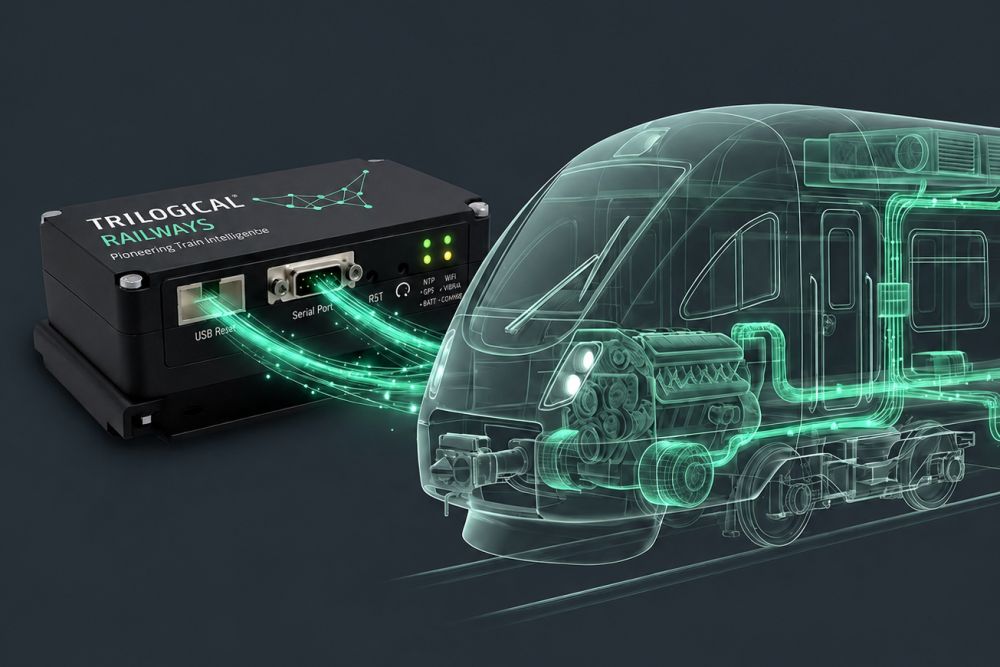
Eyal Trichter, Trilogical: Both. We have two main product areas. RailBlazer is our solution for smart freight wagons, while Control FREAK is used for locomotives, multiple units and passenger rolling stock.
With RailBlazer, we invested considerably in the hardware. We developed new sensors and worked on calibration to make the measurements more precise and better suited to customer requirements.
On the locomotive and multiple-unit side, much of the work has been in firmware, software and the backend. We are making the onboard devices smarter and developing models that can process and analyse data in real time.
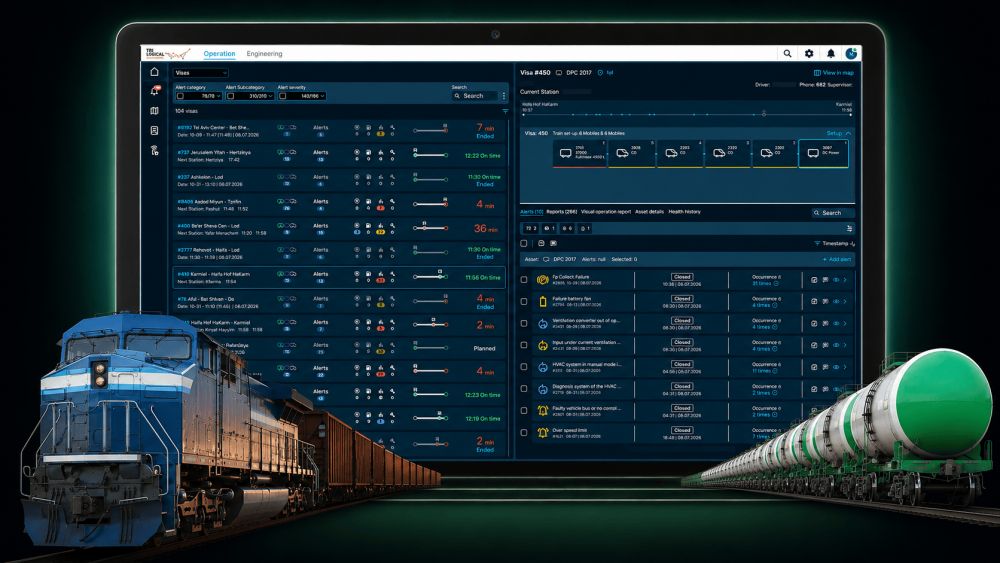
A large part of our investment has also gone into the cloud platform and the way this information is presented to operations, maintenance and engineering teams.
RM: What does that mean in practice for these three groups?
Eyal Trichter, Trilogical: Operations can see an issue during a live trip and immediately access the information needed to make a decision. They can decide what action should be taken, what information should be passed to the driver or whether the train needs to stop.
For maintenance, we provide a health indication for individual assets. The system can identify which equipment requires higher maintenance priority. The purpose is to support reliability and availability by directing attention to the assets where it is needed.
Engineering has a different requirement. Engineers want to investigate a failure, compare it with similar events and understand the conditions in which it occurred. They can develop a new analytical condition and test it on historical data before applying it to future operation.
This allows them to see how such a condition would have behaved in the past and whether it could provide an earlier warning of a critical failure.
RM: Railway companies already have their own fleet management and maintenance systems. Do they normally use your platform directly, or do you feed Trilogical data into systems they already operate?
Eyal Trichter, Trilogical: We can do both. Many customers want to continue using an internal system they already know, so we provide APIs and they can integrate our information into their own platform.
At the same time, our own platform provides much deeper analytical capabilities. For operators, maintainers, engineers and managers who want to investigate the data in detail, using our platform gives them access to more functions.
We divide it according to the requirements of operations, maintenance and engineering, but these groups can also share information and insights.
That is important because the platform gradually becomes a knowledge base. If one engineering department establishes, for example, the parameters that define an optimum engine-performance condition, this knowledge can then be applied elsewhere instead of another team starting the analysis again from the beginning.
RM: You have already deployed these newer functions with customers. Where are you seeing the clearest operational benefits?
Eyal Trichter, Trilogical: RailBlazer gives a good example.
We collect detailed information about impacts on a wagon and analyse the event so engineers can assess its severity. If an impact during loading or coupling reaches a condition where a manual inspection may be required, the system can generate an alert.
We also use statistics to examine how wagons move through an operation. If a wagon enters a specific loading area and remains there longer than the historical median for that location, the operator can be notified.
The loading process can then be connected with other events. If the same wagon also experienced significant impacts, that becomes additional information for deciding whether it requires inspection.
RM: You are therefore combining location, loading information and wagon condition rather than looking at each sensor separately?
Eyal Trichter, Trilogical: Correct. We have developed additional sensors for load monitoring and weight estimation, and we can provide information about other wagon conditions such as the handbrake status.
Imagine a group of wagons waiting for loading or departure. Without this information, an operator may not have an immediate overview of which wagons are loaded, what their condition is or whether manual attention is required.
In the application, the operator can select a group of wagons geographically and immediately receive their status. They can see whether the wagons are ready to leave for the main line, whether somebody needs to attend to a handbrake or whether an alert has been recorded.
This is where telematics starts to affect the time required for railway operations rather than simply showing dots on a map.
RM: AI is a major part of the discussion at InnoTrans, but you also said something interesting: in railway telematics, AI is not always the solution.
Eyal Trichter, Trilogical: That is something we have learned. If you already have high-quality information and well-defined operating conditions, you do not necessarily need AI for every analysis. Railway operation gives us many conditions that can be repeated and compared.
If the environmental and operational parameters are known, we can compare what happened under very specific conditions and determine what changed. In some cases, relatively few parameters remain unknown.
AI is very useful, but the quality of the source information remains critical. We should use the analytical method that produces the most accurate result for the particular application.
RM: RailBlazer is installed directly on a freight wagon. With the additional sensing and analytical functions you now offer, how complicated is a retrofit?
Eyal Trichter, Trilogical: The effort required from the customer is very small.
Once the installation design has been completed and we know where and how the device will be attached to that particular wagon, the physical installation should take around ten minutes.
After that, the system can be configured remotely or through the mobile application. There is no requirement for major physical modifications to the wagon.
The unit can normally be attached to the bogie, the wagon body or between them, depending on the application. It does not require work on the roof or at height.
Whether installation can be performed directly in an operating location naturally depends on the customer’s own safety rules, but a specialised workshop is not inherently required for the device itself.
RM: An unpowered freight wagon also means you cannot simply take electricity from the vehicle. How do you manage the RailBlazer power supply?
Eyal Trichter, Trilogical: We use a primary battery rather than relying on solar power.
The device does not need to operate every function continuously. Events such as a location report, a change in loading condition or another defined trigger can activate the required sampling or transmission.
Depending on the configuration and the technology being used, we expect a battery life of approximately six to eight years.
A lot of our development work has gone into reducing energy consumption and measuring it very precisely. We monitor the actual energy used by individual consumers inside the device, down to very short periods, instead of estimating battery condition only from voltage or current measurements.
RM: Have you already reached the point where RailBlazer batteries installed in service have had to be replaced?
Eyal Trichter, Trilogical: Not yet. The battery itself can be replaced, and the physical replacement takes around five minutes. The difficult part with a freight wagon is often reaching the wagon in the first place.
That is why long battery life and reliability are so important. A wagon may remain in operation for years before there is a convenient opportunity to access it, so the telematics equipment has to work according to the same operational reality.
RM: That becomes even more important for freight operations in remote areas where cellular coverage is poor. What happens when RailBlazer cannot reach the mobile network?
Eyal Trichter, Trilogical: There are many parameters that can be configured. We can define the number of location samples, the number of transmissions and which events should trigger specific measurements.
If information cannot be transmitted because cellular coverage is unavailable, it is retained in the device.
We also use mesh connectivity between the wagons and the locomotive. Information can therefore be passed through the train to a gateway on the locomotive, which can use cellular or satellite communication.
The mesh connection is also important for information that needs to reach the driver immediately. Examples include a derailment-related alert, movement with a handbrake applied or an End-of-Train event.
RM: Does that mean RailBlazer and Control FREAK effectively become parts of one system?
Eyal Trichter, Trilogical: They can work independently, but they can also communicate with each other.
The gateway that manages the mesh network can also communicate with the locomotive network and access locomotive sensor information and alerts.
From the user’s perspective, this means the information can be available through the same platform. If somebody wants to investigate an engine issue, a wagon handbrake alert, time spent in a certain location or equipment availability, they can work from the same user interface, provided they have the necessary authorization.
The devices themselves can communicate independently over cellular networks, while mesh connectivity provides the direct link within the train.
RM: And what does the driver see? Fleet managers and engineers may work with large dashboards, but the driver needs something much simpler in the cab.
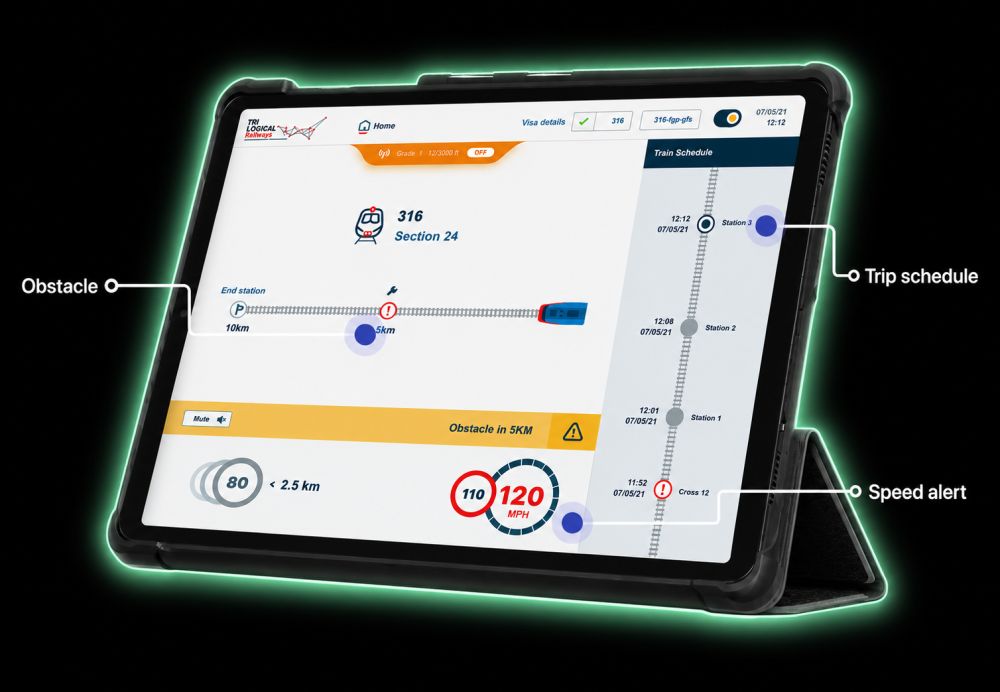
Eyal Trichter, Trilogical: For the driver, we have two options. One is a panel PC installed in the locomotive. The more common solution is a tablet.
The driver logs in and is authenticated by the server. We then download the trip plan or schedule together with information about the route and speed restrictions.
During the trip, the driver can receive information about the optimum speed, speed limits and obstacles or other information reported by the control centre or third-party sources.
Engineering can also decide which technical failures or warnings should be shared with the driver.
RM: Geographically, where is Trilogical concentrating its activities now?
Eyal Trichter, Trilogical: We already have deployment experience in Africa, Asia and South America, and we are starting new activities in the United States.
For freight wagons, the US is an important market for us. On the locomotive side, Europe is our main target.
At the same time, we continue to see opportunities in South America, Asia and Africa, so we are not leaving those markets behind.
RM: Europe is technically fragmented, with fleets from different manufacturers and different national operating environments. Does that make the European locomotive market more difficult for you?
Eyal Trichter, Trilogical: For us, it can actually make it easier.
Different manufacturers use different locomotive architectures and communication systems, and we already have experience working with a range of OEM platforms.
Our cross-platform approach is particularly relevant to operators that have locomotives or multiple units from several manufacturers. They do not have to analyse every fleet through a completely separate environment.
Europe is also a market where operators and maintainers already understand what digitalisation can contribute to maintenance, reliability and availability. The discussions are therefore often very technical. Customers know their maintenance KPIs and know what they want to measure.
RM: So what would your ideal European customer look like?
Eyal Trichter, Trilogical: I do not see one specific type of European customer that would qualify and another that would not.
Operators here generally know what they want to achieve. Maintenance performance is measured, KPIs already exist and there is data against which the benefits of a system can be evaluated.
The fleet architecture and the way operators and maintainers work also make it possible to demonstrate the effect on actual performance.
For operators with rolling stock from several manufacturers, our cross-platform approach is particularly relevant because the information can be brought into the same environment.
RM: If we meet again at InnoTrans in another two years, where do you expect the biggest technical change?
Eyal Trichter, Trilogical: I think AI will change the way railway companies work, but companies will also have to adapt their internal culture.
Technically, I expect much more emphasis on edge computing. We will capture more information on the vehicle, analyse more of it in real time and share the relevant result immediately with the driver or another stakeholder.
Instead of somebody having to investigate the system after an event, the system will increasingly provide an immediate notification, recommendation or action item.
That applies to maintainers, operators, users and shippers. The objective is to make railway operation and rail freight more efficient.
RM: We actually finished our 2024 interview talking about company culture and the difficulty of introducing new technology. Two years later, is that still the main obstacle?
Eyal Trichter, Trilogical: Mainly, yes. Changing the technology can be easier than changing the way departments work with each other – how they collect data, how they report it and how they approach a problem.
We are seeing more younger people entering the railway industry who expect to work with these kinds of digital tools. That will make deployment easier.
I am sure that when we meet again in another two years, AI will look different both from the development side and in the tools available to users.
Companies that already know how to collect high-quality information and manage large volumes of data will be in a much better position to use those tools.


